The Quiet Revolution: How Self-Service and SoftPOS Are Reshaping the Payment Terminal Landscape in 2026
"The global digital payments market is projected to grow from USD 145 billion in 2026 to USD 351 billion by 2031, at a 19.34% CAGR. But the headline number obscures a more interesting story: the fastest growth isn't coming from where you'd expect. It's coming from two quiet revolutions — self-service unattended terminals and software-based POS — that are dismantling the traditional checkout counter altogether."
Walk into any modern airport, hospital, or quick-service restaurant in 2026, and you'll notice something missing: the cashier. Not because of labor shortages — though those persist — but because the payment terminal has become the cashier. Self-service kiosks, unattended payment terminals, and pocket-sized SoftPOS devices are quietly absorbing transactions that once required a counter, a staff member, and a bulky fixed terminal.
For payment hardware manufacturers, this shift represents both an opportunity and a design challenge. The terminals of 2026 must be smarter, more secure, more compact, and capable of operating in environments their predecessors never imagined — from vending machines to taxi backseats to a delivery rider's smartphone. CIONTEK, a Shenzhen-based Android POS manufacturer trusted in over 100 countries since 2009, has been building hardware precisely for this new reality. Here's why it matters.
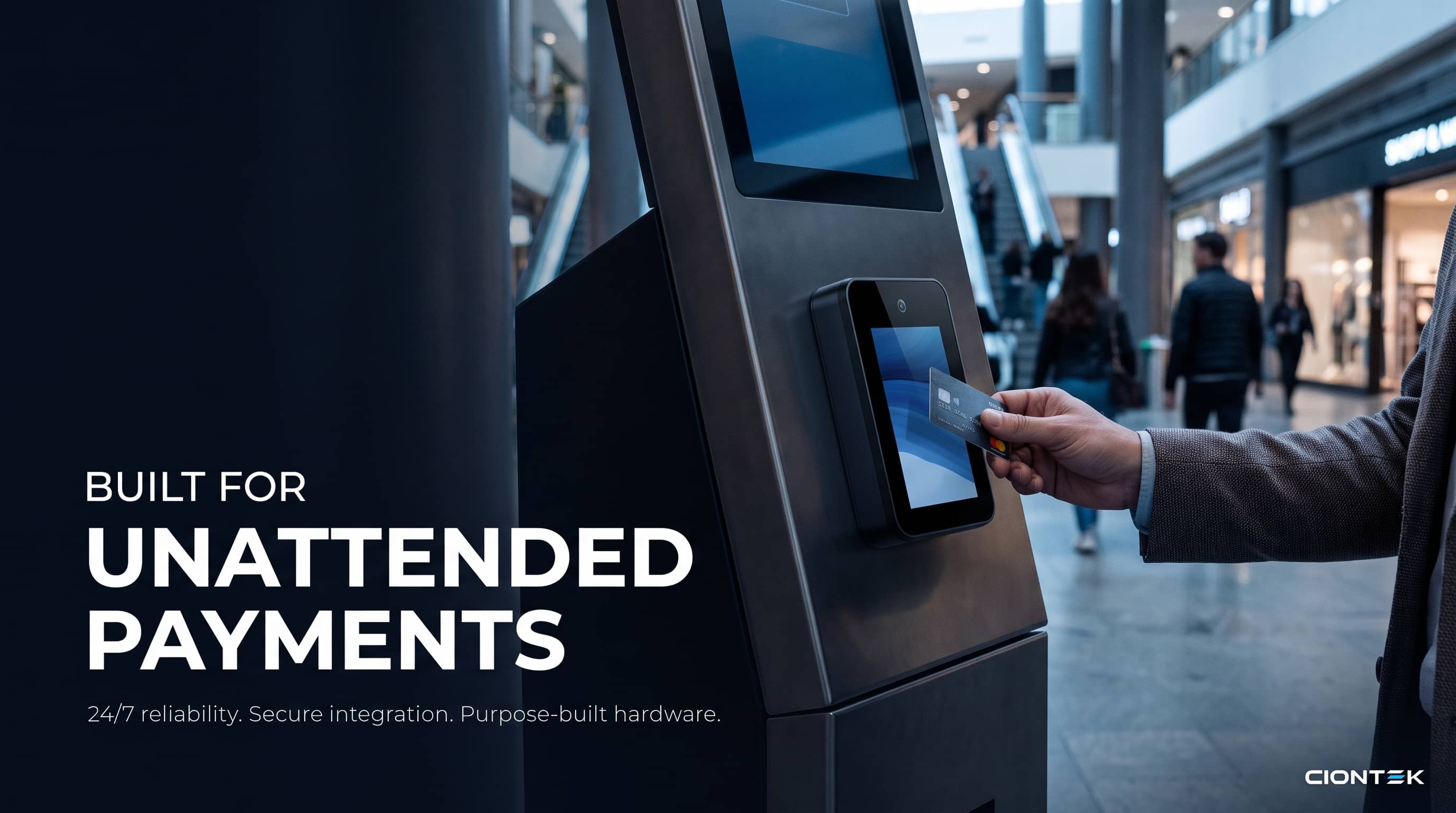
1. The Unattended Payment Boom: When the Terminal Becomes the Store
The self-service kiosk market is on a steep upward trajectory. Technavio projects USD 15.9 billion in net market growth for self-service kiosks, while the broader interactive kiosk segment grows at a 9.6% CAGR through 2030. The drivers are familiar — labor costs, 24/7 consumer expectations, and the simple economics of removing a human from a repeatable transaction.
But here's what's less obvious: the payment terminal inside that kiosk is the hardest part to get right. It must operate unattended for thousands of hours, handle contactless and chip-and-PIN transactions flawlessly, resist tampering, and remain PCI-PTS and EMV certified throughout its lifecycle. A kiosk manufacturer can build a beautiful enclosure, but if the payment terminal fails, the entire machine becomes a very expensive paperweight.
This is precisely the gap that dedicated unattended payment terminals (UPTs) fill. Rather than retrofitting a counter-top POS into a self-service enclosure, purpose-built UPTs are engineered from the ground up for unattended environments — compact form factors, ruggedized components, advanced tamper detection, and connectivity options that span 4G, Wi-Fi, and Ethernet.
The CIONTEK CM30 is a next-generation Unattended Payment Terminal designed specifically for self-service environments. With advanced security features, multi-connectivity options (4G/Wi-Fi/Ethernet), and a compact form factor engineered for kiosk integration, the CM30 delivers 24/7 payment reliability where no staff member is present to reboot a frozen terminal. A transportation-specific variant, the CM30V, extends the same architecture to transit fare collection — where speed, durability, and uptime are non-negotiable.
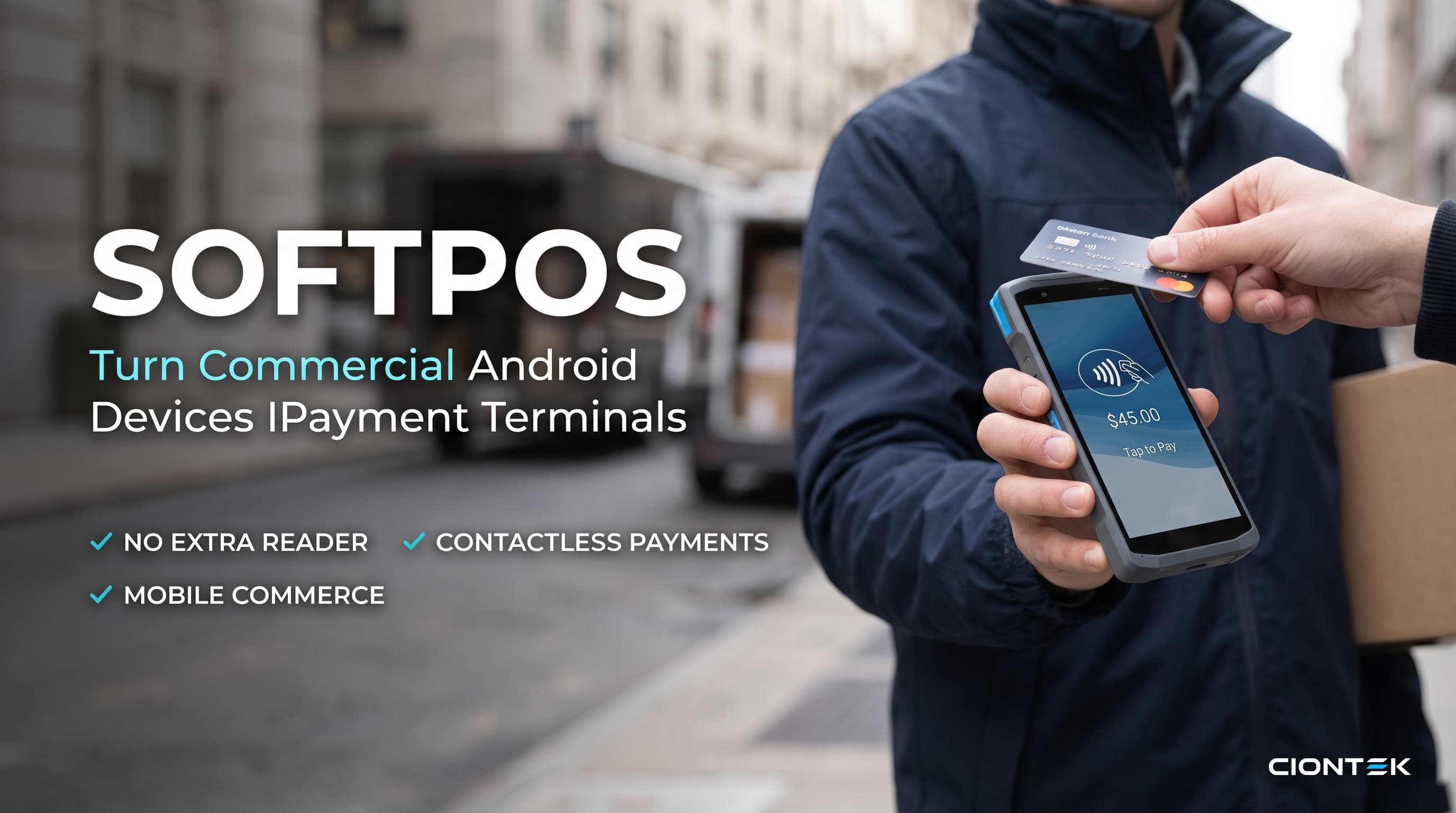
2. SoftPOS: The Terminal That Disappears Into Your Phone
If unattended terminals represent the expansion of payment hardware into new physical spaces, SoftPOS represents its disappearance entirely. SoftPOS — also known as Tap-to-Pay-on-Phone or Tap-on-Mobile — turns a standard NFC-equipped Android smartphone or tablet into a fully certified contactless payment terminal, with no additional hardware required.
The technology leverages host card emulation (HCE) and hardware-level secure environments to protect card data at the point of tap. Major players including IDEMIA, Ingenico, and NMI have launched commercial SoftPOS platforms, and the market is expanding fast. Industry forecasts project significant SoftPOS shipment growth through 2026, with Ingenico and Verifone leading in banking and chain retail channels while lower-cost Android-based solutions capture emerging markets and micro-merchant segments.
The appeal is obvious: a delivery driver, a market stall owner, or a pop-up retailer can start accepting contactless card payments in minutes — no dongle, no terminal rental, no waiting for hardware procurement. For acquirers and payment service providers (PSPs), SoftPOS dramatically lowers the cost of merchant acquisition, especially in markets where traditional terminal deployment economics don't work.
But there's a catch. Not every Android device is suited for SoftPOS. Consumer-grade phones lack the thermal management, scanner integration, printer support, and ruggedization that commercial use demands. The sweet spot is a purpose-built commercial Android device that supports SoftPOS as one of many capabilities — not a phone pretending to be a terminal, but a terminal that happens to run SoftPOS software.
The CIONTEK CS30G is positioned as the ultimate SoftPOS solution — a commercial-grade Android device that transforms into a secure contactless payment terminal. Unlike consumer phones repurposed for payment, the CS30G is engineered for daily commercial abuse: integrated printer, ruggedized build, and the scanner, connectivity, and battery life that real-world merchants demand. It's the bridge between the SoftPOS software revolution and the hardware reliability that PSPs and acquirers actually need to deploy at scale.
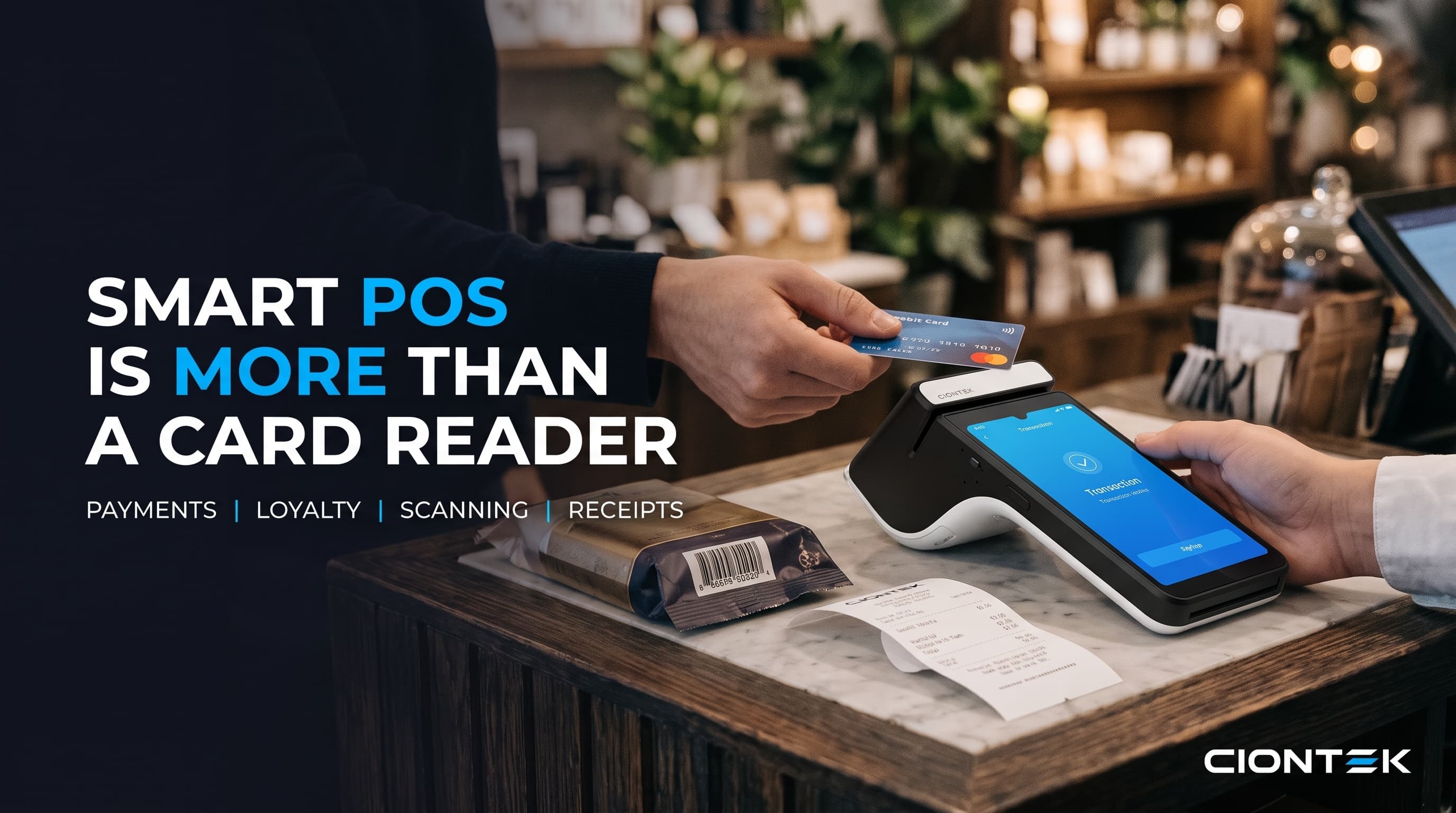
3. Contactless Is Now the Default — and Smart POS Must Keep Up
The numbers tell the story. According to Euromonitor International data cited by The Paypers, global mobile payment transaction value reached USD 8.15 trillion across 47 markets in 2024 — a 12% year-on-year increase. The market is projected to reach USD 12.53 trillion by 2029. Digital wallets now account for roughly half of all global transactions, and contactless tap-to-pay has moved from a novelty to an expectation.
For merchants, this means the smart POS terminal is no longer just a card reader. It's the hub of the entire in-store experience — running loyalty apps, displaying promotions on a customer-facing screen, scanning barcodes, printing receipts, and processing payments across every major method: EMV chip, contactless NFC, mobile wallets (Apple Pay, Google Pay, Alipay, WeChat Pay), and QR codes.
The terminals that win in this environment are those built on modern Android — not legacy embedded OS platforms that struggle with app ecosystems, security patching, and developer adoption. Android gives ISVs and system integrators an open platform to deploy omnichannel retail, hospitality, and banking applications. It also means faster certification cycles, easier remote management, and a longer useful life as payment standards evolve.
The flagship CIONTEK CS50S runs on Android 16 — the latest OS in the POS industry — and features an innovative dual-screen design for simultaneous merchant operation and customer-facing display. It delivers full EMV Level 1 and Level 2 certification, high-speed NFC contactless support, and bank-grade transaction security out of the box. For merchants who need mobility, the CIONTEK CS20 offers a compact, portable payment solution that doesn't sacrifice on scanning, printing, or connectivity — ideal for queue-busting, pop-up retail, and field service scenarios.
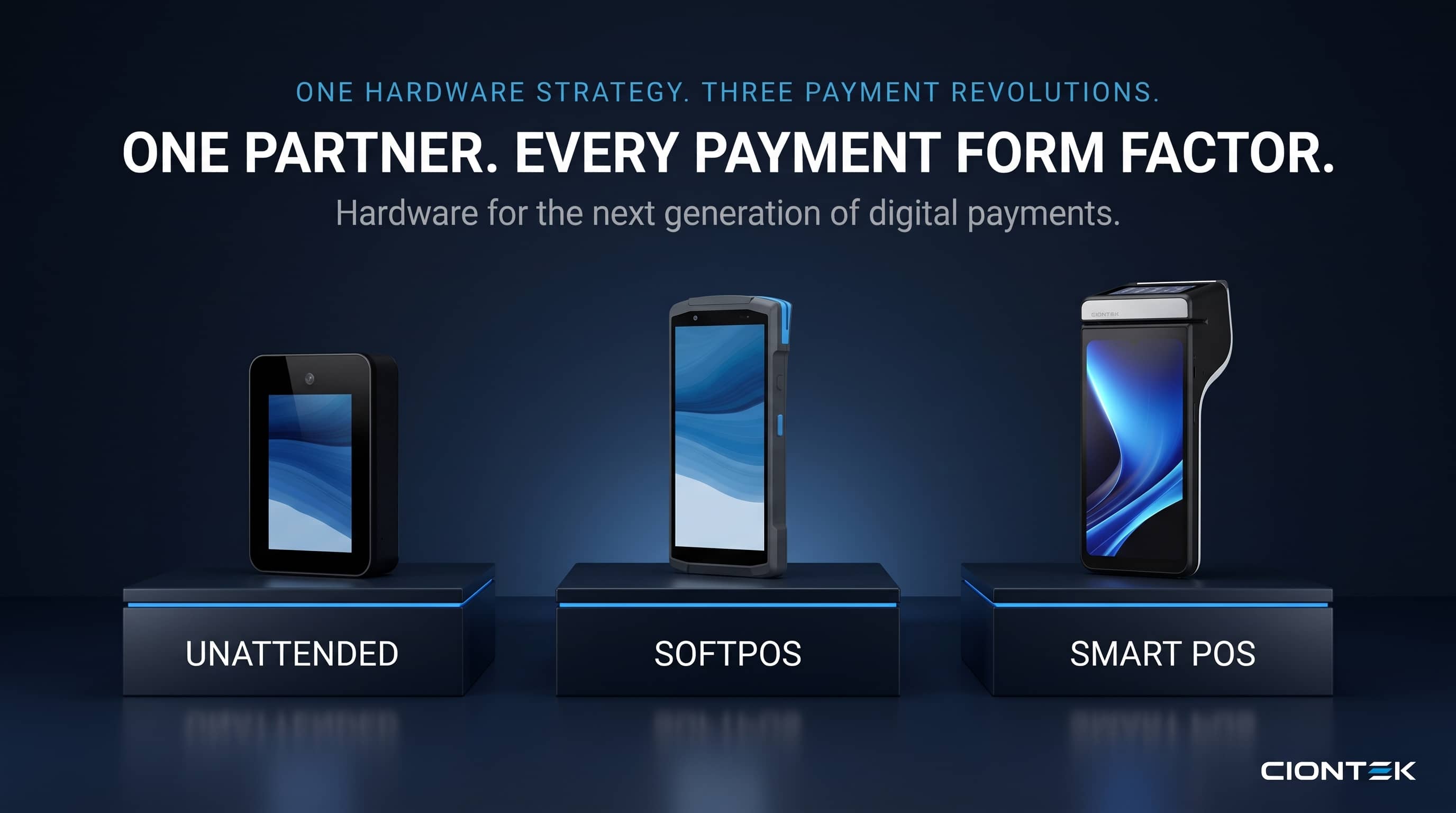
4. The Convergence: One Hardware Strategy for Three Revolutions
Here's what ties these trends together. A modern payment hardware strategy can no longer be one-size-fits-all. A retailer might need unattended kiosks in their self-checkout area, SoftPOS on a fleet of delivery devices, and a full-featured smart POS at the service counter — all from the same vendor, all running the same Android application stack, all managed through the same remote device management platform.
This is the bet CIONTEK has been making since 2009. With a product lineup that spans UPTs (CM30, CM30V), SoftPOS (CS30G), smart POS (CS50, CS50S), and mobile POS (CS20), CIONTEK offers a single hardware partner across every payment form factor a business might need. Every device is built on Android, EMV-certified, and designed for the global market.
For PSPs, acquirers, system integrators, and ISVs evaluating hardware partners in 2026, the questions that matter have shifted:
- Coverage: Can one vendor supply terminals for attended, unattended, and mobile scenarios — reducing integration complexity?
- Platform consistency: Do all devices run the same OS and SDK, so an app developed once deploys everywhere?
- Certification depth: Are devices pre-certified for EMV L1/L2, PCI, and regional payment schemes — or will certification be a months-long deployment bottleneck?
- Supply chain reliability: Can the vendor scale from pilot to volume deployment without quality drift, and provide global after-sales support?
CIONTEK's answer to all four is yes — and its fifteen-year track record of serving banks, transportation authorities, and retail chains across Asia, Africa, Europe, and the Americas is the proof.
5. What's Next: Tokenization, Open Banking, and the Terminal as a Platform
Looking beyond 2026, three forces will continue to reshape payment hardware:
- Tokenization will go deeper. Replacing card numbers with algorithm-generated tokens — already standard in digital wallets — will extend to in-person transactions, reducing fraud at the terminal level. Terminals must support token-based contactless flows, not just PAN-based ones.
- Open banking will reach the terminal. Account-to-account (A2A) payments that bypass card networks entirely are growing rapidly in Europe and Asia. Smart POS terminals will increasingly serve as endpoints for A2A QR-code or NFC-initiated flows, not just card acceptance devices.
- The terminal becomes a platform, not a peripheral. With Android at the core, the POS terminal is evolving into a general-purpose business computing device — running inventory, CRM, loyalty, and even AI-powered analytics at the edge. Hardware that can't support this app ecosystem will be left behind.
CIONTEK's Android-first architecture means its terminals adapt to emerging payment standards through software updates — no rip-and-replace when the industry shifts. That's the difference between an investment and a sunk cost.
The CIONTEK CS30 is the proof point. Running Android 14 on a quad-core processor, it packs a built-in Zebra 1D/2D barcode scanner, NFC contactless reader, 4G/Wi-Fi/Bluetooth connectivity, and an integrated 58mm thermal printer into a slim 17mm pocket-sized body. One device handles mobile payments, QR-code scanning, label scanning, and membership or canteen use — replacing an entire checkout stack with something that fits in a pocket. As SoftPOS, contactless, and QR convergence accelerates, the CS30 is built to keep pace through software evolution rather than hardware replacement.
Conclusion: Smart & Reliable, Now More Than Ever
The payment terminal market of 2026 looks nothing like the market of 2016. Terminals have left the counter — they're in kiosks, in pockets, on delivery bikes, and in taxi backseats. They run Android, not embedded Linux. They accept contactless, QR, and soon A2A — not just magstripe and chip. And they're expected to do all of this while being more secure, more compact, and more reliable than ever before.
For businesses navigating this landscape, the choice of hardware partner has never mattered more. A terminal isn't just a card reader anymore — it's the point where every payment method, every customer interaction, and every security standard converges. Choose one that's been getting it right since 2009.
Choose Smart & Reliable. Choose CIONTEK
Ready to Transform Your Payment Experience?
Join thousands of businesses worldwide who trust CIONTEK for their Android commercial terminals.
From unattended kiosks to SoftPOS to smart POS — one partner, every form factor.